
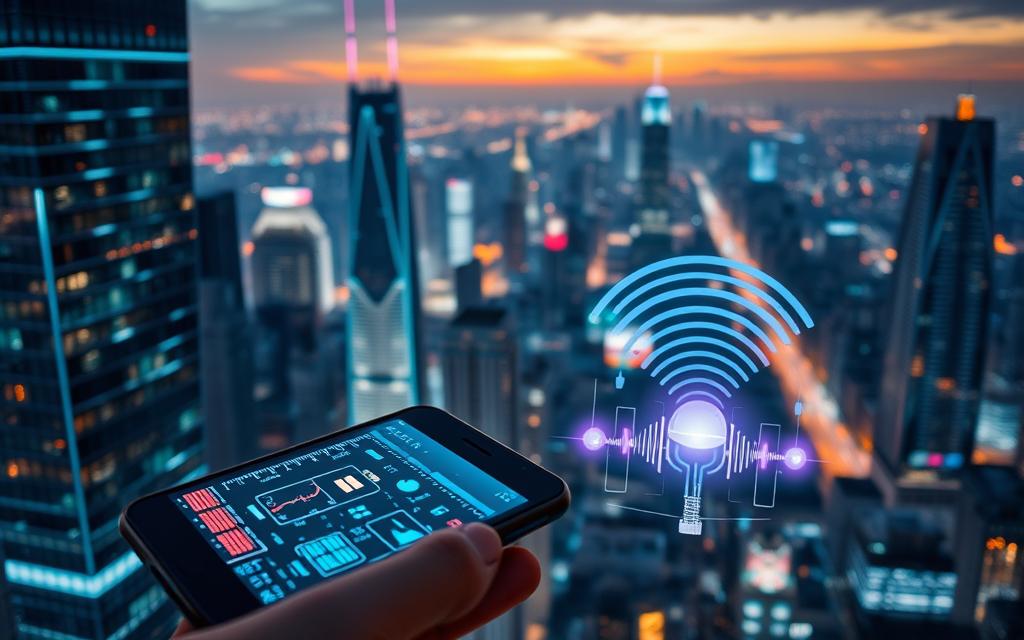
Imagine a world where every light source can send data. This idea is at the heart of LiFi technology, a new way to wireless data transmission.
Professor Harald Haas showed us this amazing tech in 2011 at TEDGlobal. It changes how we see connectivity.
Unlike Wi-Fi, LiFi uses light to send information. It works by quickly changing the brightness of LED lights, which we can’t see.
It turns light pulses into digital signals that devices can understand. This opens up a new way to communicate, better than old methods.
This is just the start of learning about visible light communication. It’s going to change how we connect in our digital world.
What Is LiFi Technology
LiFi is a new way to send data using light instead of radio waves. It turns regular lights into fast data senders. This changes how we connect to the internet.
Fundamental Principles of Light Communication
LiFi uses light to send messages. It works with light we can see, and some we can’t. The light’s brightness changes fast, too quick for us to notice.
This change in light lets us send led data transmission through lights we use every day. Special detectors pick up these changes and turn them back into signals we can use.
Related Posts:





The idea behind LiFi is based on vlc visible light communication. Lights send data by changing how bright they are. This is done without affecting their main job of lighting up our spaces.
Origin and Naming by Harald Haas
The idea of using light for data started with early research. In 2009, the Fraunhofer Institute showed it could work. They proved light could carry data.
Early Experiments and Research
At first, scientists tested if light could carry data. They found out that light could send data streams well. They also made sure the lights could keep lighting up our spaces.
These early tests showed light could carry more data than radio waves. This was a big discovery.
Coining the Term “LiFi”
Professor harald haas made LiFi famous in 2011. He showed a video being sent through a light bulb. This was a big moment.
“All we need to do is fit a small microchip to every possible light source. This way, we can use lights for both light and wireless data.”
Haas’s ted talk introduced LiFi to the world. He showed how lights could send data. This changed how we think about connecting to the internet.
The name LiFi means “Light Fidelity.” It’s like WiFi but uses light. This name made it clear LiFi is a new way to connect.
Professor harald haas kept working on LiFi. He started a company called PureLiFi. His work helps make LiFi a part of our daily lives.
Mechanisms Behind LiFi Operation
To grasp LiFi, we must look at its core parts and how it processes signals. This tech turns regular light into a fast data carrier through clever engineering.
Key Components: Transmitters and Receivers
The LiFi system has two main parts that work together. They change digital info into light and back again.
Role of LED Bulbs in Data Transmission
LED bulbs are the main lifi transmitter. They change light intensity quickly, much faster than we can see. This fast change makes binary patterns that carry digital data.
Standard LED bulbs can be easily changed for LiFi use. This makes it great for updating old lighting systems.
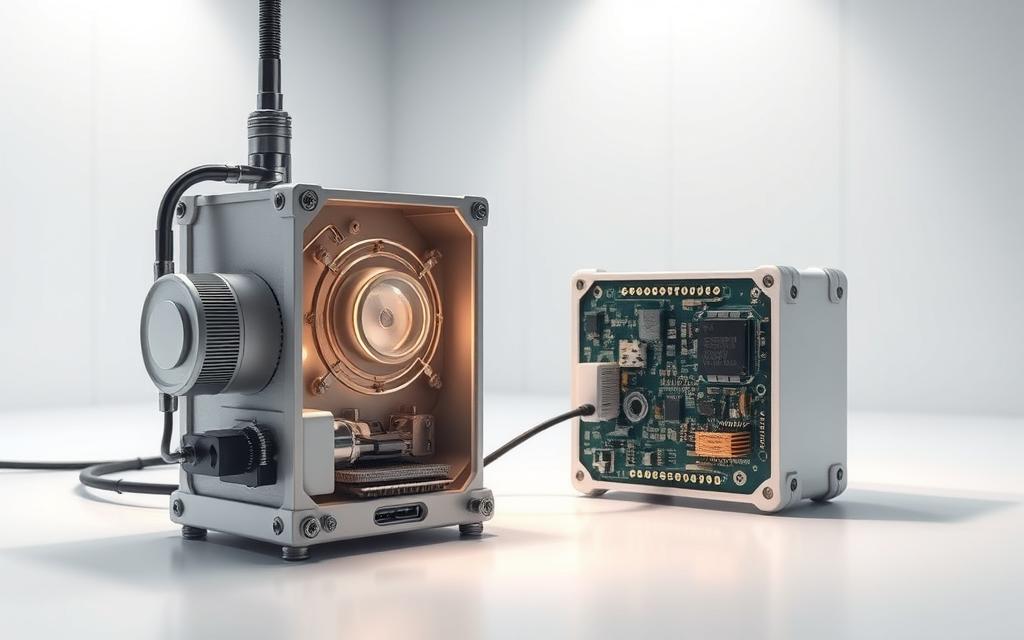
The lifi receiver has a photodetector that catches light changes. It turns light signals back into electrical signals for processing.
Today’s photodetectors are very sensitive. They can spot small light changes. This lets them accurately read data even in tough lighting.
Data Encoding and Transmission Process
Turning digital data into light signals uses complex encoding. This method makes sure data is sent efficiently and correctly.
Modulation Methods for Light Signals
LiFi uses advanced modulation to encode data on light waves. Orthogonal Frequency Division Multiplexing (O-OFDM) is a common method.
This method splits data streams across many sub-carriers in the light spectrum. It uses the bandwidth well and keeps signals clear.
Decoding and Data Retrieval
The receiver does complex data encoding reversal. Special algorithms rebuild the original data from light patterns.
Systems correct errors to keep data accurate, even with interference. They adjust for signal loss due to distance or obstacles.
Best performance is with direct line-of-sight. But, reflected signals can also connect. This flexibility helps with device placement, despite range limits.
Benefits of Utilising LiFi for Wireless Communication
Companies looking into LiFi will find big wins in speed, security, and being kind to the environment. These lifi benefits are big steps up from old wireless tech, mainly in places where the usual stuff doesn’t cut it.
Superior Speed and Bandwidth Performance
LiFi tech moves data at rates way beyond what’s normal. In lab tests, speeds have hit over 224 Gbit/s. This is because light has a huge frequency range, giving LiFi a lot more bandwidth than radio waves.
The light spectrum has about 10,000 times more bandwidth than radio waves. This means LiFi can handle lots of users without slowing down. Everyone can get fast internet at the same time.
Enhanced Security Through Localised Signals
LiFi is super secure because it uses light signals that don’t go far. Unlike radio waves, light stays put, making it hard for outsiders to get in. This makes LiFi great for keeping data safe.
LiFi signals can’t be picked up from far away. Anyone trying to tap into it has to be right there. This adds a strong lifi security layer that other wireless tech can’t match without extra encryption.
For places that need to keep data secret, LiFi is a big win. Banks, government offices, and research labs can use it without worrying about hackers.
Minimised Electromagnetic Interference
LiFi doesn’t send out radio waves, making it perfect for places that can’t handle them. Hospitals can use it near MRI machines without worrying about disruptions. Airplanes use LiFi for movies and shows without messing with navigation.
LiFi doesn’t cause electromagnetic interference emi problems. This is great for places where clean electromagnetic fields are key. Labs and factories can use it without messing with their work.
This is also good for places where radio waves could be dangerous. Places like oil refineries and ammo dumps can use wireless tech safely.
| Benefit Category | Performance Metric | Application Advantage | Comparative Improvement |
|---|---|---|---|
| Speed Performance | 224+ Gbit/s demonstrated | High-density user support | 100x typical WiFi speeds |
| Security Enhancement | Signal containment within rooms | Physical access requirement | Eliminates remote interception |
| EMI Reduction | Zero RF interference | Sensitive environment compatibility | Enables use in prohibited areas |
| Bandwidth Capacity | 10,000x RF spectrum | Future-proof scalability | Massive data handling capability |
LiFi’s lifi benefits make it a strong choice for certain needs. It’s not a total replacement for old wireless tech, but it offers special perks. Companies can use LiFi to improve their networks where usual tech doesn’t work.
Challenges and Limitations in LiFi Deployment
LiFi has many benefits, but it faces some big challenges for wide use. These issues limit LiFi’s use in different places.
Dependence on Line-of-Sight Connectivity
LiFi needs a clear path between the sender and receiver. This makes it hard to use in places with obstacles. Any blockage can stop the signal.
Setting up lighting is key. Rooms need special LED lights for good coverage. This is different from radio waves that can go through some things.
Limited Range and Obstruction Sensitivities
LiFi signals don’t go far, about 10 metres at best. This means many access points are needed for full coverage.
Light from the sun can also mess with LiFi. Artificial lights can cause problems if not set up right.
Things like furniture and people can also block signals. This makes it hard to keep connections stable.

Compatibility with Current Network Systems
Getting LiFi to work with old systems is hard. Many places have WiFi and ethernet that need to work with LiFi.
LiFi needs special hardware to work. Regular devices can’t use it without extra adapters. This makes it expensive and hard to use.
Managing networks with LiFi is also a big task. IT teams must make sure it works well with old systems.
“Moving to light-based systems is a big change. It’s promising, but getting it to work with old systems is a big challenge.”
| Limitation Factor | Impact Level | Potential Solutions | Deployment Cost Implication |
|---|---|---|---|
| Line-of-Sight Requirement | High | Strategic lighting placement | Increased installation costs |
| Range Restrictions | High | Denser access point network | Higher equipment investment |
| Sunlight Interference | Medium | Advanced filtering technology | Additional component costs |
| Device Compatibility | Medium | Universal receiver development | Consumer adoption barrier |
| Network Integration | High | Hybrid system management | IT infrastructure upgrades |
LiFi’s problems are not permanent. Scientists are working hard to solve these issues. They aim to keep LiFi’s benefits while fixing its problems.
Real-World Applications of LiFi Technology
LiFi technology has moved from theory to real-world use in many industries. These lifi applications show how light-based communication solves problems that old wireless tech can’t.
Healthcare Settings for Secure Data Transfer
Hospitals and medical facilities get a lot from healthcare lifi solutions. It keeps patient data safe during transmission.
Medical gear often works in places where radio waves can cause trouble. LiFi fixes this issue, giving reliable internet for machines and monitoring systems.
Aviation for In-Flight Internet Services
The aviation world uses aviation lifi for internet in the cabin. It doesn’t mess with the plane’s systems, keeping everyone safe.
Passengers get fast internet without risking the plane’s instruments. This makes flying better and safer.
Smart Home Integration with IoT Devices
Smart home iot gets better security with LiFi. It makes separate networks that keep out unwanted visitors.
Home automation works better with less interference and more reliability. Many devices can connect at once, without the usual slowdowns.
Industrial Utilisation in Manufacturing
Manufacturing uses LiFi for strong industrial automation. It helps machines talk to control systems in real-time.
BMW showed how well LiFi works in factories. It keeps automated vehicles and robots connected and working smoothly.
Warehouses use LiFi for exact indoor location systems. This helps manage stock and improve logistics in big storage areas.
| Application Sector | Primary Benefit | Implementation Example | Data Transfer Speed |
|---|---|---|---|
| Healthcare Facilities | EMI-Free Operation | Medical Equipment Connectivity | Up to 100 Gbps |
| Aviation Industry | Aircraft System Safety | In-Flight Entertainment | 10-15 Gbps |
| Smart Home IoT | Enhanced Security | Device Network Integration | 5-10 Gbps |
| Industrial Manufacturing | Reliability in RF Noise | Automation System Control | 20-30 Gbps |
These lifi applications show how versatile LiFi is in different places. From hospitals to factories, LiFi solves problems that old tech can’t.
For more examples of how companies use LiFi, check out these real-world lifi use cases. They show how LiFi is used in practice.
LiFi is growing in many areas as it gets better and more people use it. Each area uses LiFi’s special benefits to solve its own problems.
LiFi Versus WiFi and Other Wireless Standards
When we look at wireless communication, it’s key to know the differences between technologies. WiFi has been the top choice for years. But LiFi offers something new and worth thinking about.
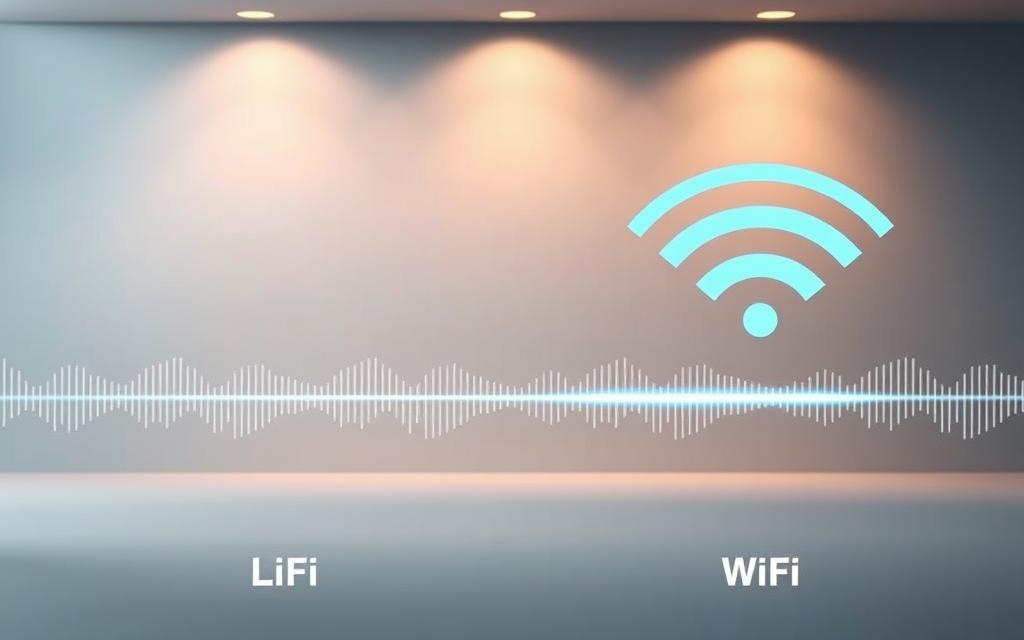
Performance Comparison: Speed and Latency
LiFi is way faster than traditional wireless standards. Tests have shown LiFi speeds over 100 Gbps, much faster than WiFi.
LiFi also has lower latency. This makes it great for applications that need quick responses, where every millisecond counts.
But WiFi is better at reaching far and going through obstacles. LiFi needs a direct view to work, unlike WiFi’s signals that can pass through walls.
Security Advantages Over Radio Frequency Technologies
LiFi is much safer than RF systems. Light signals can’t go through solid objects, making communication areas secure.
This security stops hackers from getting into the network. Unlike RF signals, LiFi stays in the area it’s lit up.
Places with sensitive info find LiFi very useful. It creates safe zones that outsiders can’t get into.
Synergistic Use with Existing Wireless Networks
LiFi isn’t meant to replace WiFi. Instead, it’s meant to work together with it. This way, both can do their best jobs.
LiFi is perfect for areas needing lots of bandwidth and security. WiFi is better for covering more space in buildings.
By using both, networks can get better. Devices can switch between LiFi and WiFi based on where they are and what they need.
Here’s how to set it up:
- Put LiFi access points in places like conference rooms and secure areas.
- Keep WiFi for the rest of the office.
- Use smart handover between networks.
- Manage both with one system.
This way, you get the most out of your current setup. And you can add LiFi where it really makes a difference.
Current Adoption and Market Leaders in LiFi
LiFi technology is moving from labs to real-world use in many areas. This shows it’s more than just a theory. Leaders in the field are making it work in everyday life through new products and projects.

Global Pilot Programmes and Trials
Schools like Kyle Academy in Scotland are among the first to use LiFi. They’ve made their whole school LiFi-enabled for fast internet. This is a big test of how well LiFi works in schools.
Success at Kyle Academy has led to more trials in offices and public places. These tests help figure out how well LiFi works and what problems it might cause. They also build trust in LiFi for others to use.
Prominent Companies: PureLiFi, Oledcomm, and Signify
Companies like PureLiFi are leading the way in LiFi. They make key parts and whole systems. Their work on standards is helping shape the future of LiFi.
Oledcomm is known for its big shows at events like the Paris Air Show. They show how LiFi can be used in transport. They keep working on solutions for different needs.
Signify (formerly Philips Lighting) brings a lot of knowledge from the lighting world. They make lights that also send data. This is a smart way to get LiFi into more places.
Terra Ferma has also joined the market with their own LiFi products. Each company adds something special to the growing world of LiFi.
| Company | Primary Products | Key Markets | Notable Achievements | Commercial Status |
|---|---|---|---|---|
| PureLiFi | Components and complete systems | Enterprise, healthcare | Global standards development | Commercial products available |
| Oledcomm | Customised solutions | Aviation, retail | Paris Air Show demonstration | Pilot deployments |
| Signify | LiFi-enabled luminaires | Office, industrial | Integration with lighting systems | Commercial availability |
| Terra Ferma | Specialised LiFi products | Various sectors | Market entry with innovative approaches | Early commercial stage |
Working together, lifi companies and early users help make LiFi better. Real-world tests lead to better products. This helps LiFi grow and be used in more places.
Future Directions and Innovations in LiFi
LiFi technology is evolving fast, thanks to the hard work of researchers and engineers. They are making big strides in how we connect and talk in our digital world.
Emerging Technologies and Enhancements
LiFi is getting better, with new ways to send data and faster speeds. In July 2023, a big step was taken with the IEEE 802.11bb standard. This standard makes sure different LiFi systems can work together smoothly.
This standard helps more people use LiFi and makes it cheaper. Scientists are also working on new ways to send data even faster. Some tests have shown speeds over 100 Gbps.

Other improvements include better receivers for use in less direct light. There are also plans for systems that can switch between light and radio waves. These changes help LiFi work better in more places and keep it safe.
The market is growing fast, with predictions of 17% to 63% growth from 2023 to 2030. This shows how much people believe in LiFi’s future.
Integration with Future Networks like 6G
LiFi is set to play a big role in the next generation of wireless networks. The development of 6G networks is very exciting for LiFi.
LiFi could be the fast layer in these networks, working alongside other tech. In 6G, LiFi could offer:
- Extremely high-density connectivity in crowded spaces
- Enhanced security for sensitive applications
- Reduced spectrum congestion in radio-frequency saturated environments
- Precision indoor positioning capabilities
The IEEE 802.11bb standard is key for LiFi to work well with other networks. This is important for LiFi to be widely used in 6G and other advanced systems.
Research is looking into how LiFi can work with other new tech. Together, they could make networks faster, safer, and use less energy than today’s.
Conclusion
LiFi technology is a big step forward in fast wireless communication. It uses light to send data quickly and securely. This method cuts down on electromagnetic interference and gives strong local signals.
But, LiFi faces challenges like needing a clear line of sight and a limited range. Companies like PureLiFi and Signify are working hard to solve these problems. They show that the market believes in LiFi’s future.
LiFi is not meant to replace WiFi but to work alongside it. It opens up new ways to connect. This could make our networks even better.
LiFi is getting better and more standardised. It’s set to make our wireless world more flexible and efficient. Its impact on future communication is huge.
FAQ
What is LiFi technology?
LiFi, or Light Fidelity, is a fast wireless tech that uses LED bulbs to send data. It works with visible, ultraviolet, and infrared light. This makes it a secure and efficient choice compared to Wi-Fi.
How does LiFi work?
LiFi changes the light from LED bulbs very quickly. This change is too fast for us to see. A special detector picks up this change and decodes the data. This way, LiFi can send and receive data through light.
Who invented LiFi and when was it introduced?
Professor Harald Haas introduced LiFi in his 2011 TED Talk. He showed how to send data using light. But, the idea of using light for communication started earlier, with work by places like the Fraunhofer Institute.
What are the main advantages of using LiFi?
LiFi has many benefits. It can go very fast, even faster than 224 Gbit/s in labs. It’s also very secure because light can’t go through walls. This makes it great for places where Wi-Fi can’t be used, like hospitals.
What are the limitations or challenges of LiFi?
LiFi needs a clear line of sight to work well. Anything in the way can mess up the signal. It also needs more access points than Wi-Fi, which can be a problem. Making it work with current wireless systems is also a challenge.
In which real-world applications is LiFi being used?
LiFi is used in many areas. In healthcare, it keeps patient data safe. In planes, it gives passengers internet. It’s also used in smart homes and factories for reliable data transfer.
How does LiFi compare to Wi-Fi?
LiFi and Wi-Fi are different. LiFi uses light for faster speeds and better security. Wi-Fi uses radio waves for longer range. LiFi is seen as a complement to Wi-Fi, not a replacement.
Which companies are leading in LiFi technology development?
Companies like PureLiFi, Signify, and Oledcomm are leading in LiFi. PureLiFi works on components and systems. Signify makes LiFi-enabled lights. Oledcomm showed LiFi at the Paris Air Show.
What is the future outlook for LiFi technology?
LiFi’s future looks bright. Research is improving its speed and reliability. The IEEE 802.11bb standard will help it grow. LiFi might be part of future networks, including 6G.
Is LiFi secure for sensitive data transmission?
Yes, LiFi is very secure. Light can’t go through solid walls, so it’s hard to intercept. This makes it perfect for places where data must stay private.
Can LiFi work without a direct line of sight?
LiFi works best with a direct line of sight. But, it can also use reflected light. This might make it less reliable and slower. Things in the way and reflections affect its performance.
Are there any pilot programmes or real-world deployments of LiFi?
Yes, there are many pilot projects around the world. For example, Kyle Academy in Scotland is testing LiFi for learning. These projects show how LiFi is being used in real life.