
Industrial lifting equipment is key in today’s manufacturing and construction. It makes moving heavy loads safe and easy, something humans can’t do alone.
The chain hoist works on simple mechanical principles. It lets workers lift big weights with little effort. This is thanks to its design of gears and chains.
Knowing how to use manual hoists is vital for safety and work efficiency. It ensures these tools work well and keeps everyone safe.
This technology is used in many places like building sites, factories, and warehouses. It helps these places work better and more reliably.
The main idea is to turn a small force into a lot of lifting power. This makes handling heavy loads easier and more efficient in work settings.
Understanding the Fundamentals of Chain Block Systems
Learning how chain blocks work is key for safe and effective use. These devices use old but refined ideas from engineering history.
The Basic Principles of Mechanical Advantage
Chain blocks lift heavy loads with a clever trick. They use mechanical advantage principles to make a small effort produce a big result.
Gears and pulleys are arranged to multiply the effort. This makes lifting heavy things easier, needing less physical strength.
How Pulley Systems Multiply Force
Pulleys are at the heart of pulley system force multiplication. Each pulley adds more power, not just a bit more.
Related Posts:
- What Is Industry 4.0 Technology The Fourth…

- Companies Developing Blockchain Technology Leaders…

- How Technology Is Used in Entertainment From CGI to…

- How Technology Is Used in Schools Today Modern…

- What Is Canvas Technology The Learning Management…

- What Is Apex Technology A Look at the IT Services Company

For example, a 100:1 gear ratio means lifting 100 kg with just 1 kg of effort. This makes heavy loads feel much lighter.
The Physics Behind Load Distribution
Load distribution physics spreads weight evenly. This keeps the system balanced and safe.
It also keeps the structure strong during lifting. This is key for safety and avoiding damage.
Historical Development of Chain Hoists
The history of lifting technology is both interesting and important. Modern chain blocks owe a lot to centuries of innovation.
Early Innovations in Lifting Technology
The chain hoist history starts with ancient rope and pulley systems. These early tools showed the basic ideas behind today’s chain blocks.
In the Middle Ages, better pulleys were made. These helped build huge structures that would have been impossible by hand.
Modern Advancements in Chain Block Design
The Industrial Revolution changed chain block technology a lot. New gears and strong chains made these devices much more powerful.
Today, we have even better materials and design thanks to computers. These modern hoists are lighter, stronger, and safer, yet they work on the same basic ideas.
What Is Chain Block Technology
Chain block technology is a complex system for lifting things up in many industries. It uses parts that work together to lift things safely and accurately.
Defining the Core Technology
At its heart, chain block tech uses metal chains to lift things. It turns manual or electric input into controlled movement up and down.
Key Components and Their Functions
Each chain block system has key parts for it to work right:
- Hand Chain: The part the operator moves to start lifting
- Load Chain: The strong chain that holds the weight
- Gears: These parts make the lifting force stronger
- Hooks: Where you attach the load safely
- Brake System: Stops the load from falling by accident
Each part is vital to the chain block definition. Together, they make a reliable lifting solution that balances power and control.
Difference Between Chain and Wire Rope Systems
Choosing between chain and wire rope systems is a big decision. Chain systems use metal links, while wire rope hoists use steel cables.
Chain systems are more precise and durable in tough conditions. Wire rope systems lift faster and are smoother for some jobs.
Chain blocks need less oil and can handle rougher conditions. The chain vs wire rope choice depends on what you need and where you work.
Types of Chain Used in Block Systems
Choosing the right chain is key for safe and effective lifting. Manufacturers make different chains for different loads and conditions.
Grade 80 Alloy Steel Chain Specifications
The Grade 80 alloy chain is the top choice for chain blocks today. It’s made to last and perform well.
Its specs include:
- Minimum breaking strength of 80,000 psi
- It wears less than lower-grade chains
- It lasts longer under repeated use
- It’s lighter but just as strong
This chain is strong and flexible, making it good for many jobs.
Heat Treatment Processes for Durability
Heat treatment is a key step in making chains last longer. It heats and cools the steel to change its structure.
This process makes the chain stronger and more flexible. It also makes it better at resisting wear and impact. This means the chain can last longer in tough environments.
The right mix of alloy and heat treatment makes chains strong and safe for hard work.
Mechanical Components of Chain Blocks
Chain blocks are complex systems with many parts working together. They lift loads safely and efficiently. Key parts include the load chain, gears, and safety brakes.
Load Chain and Its Characteristics
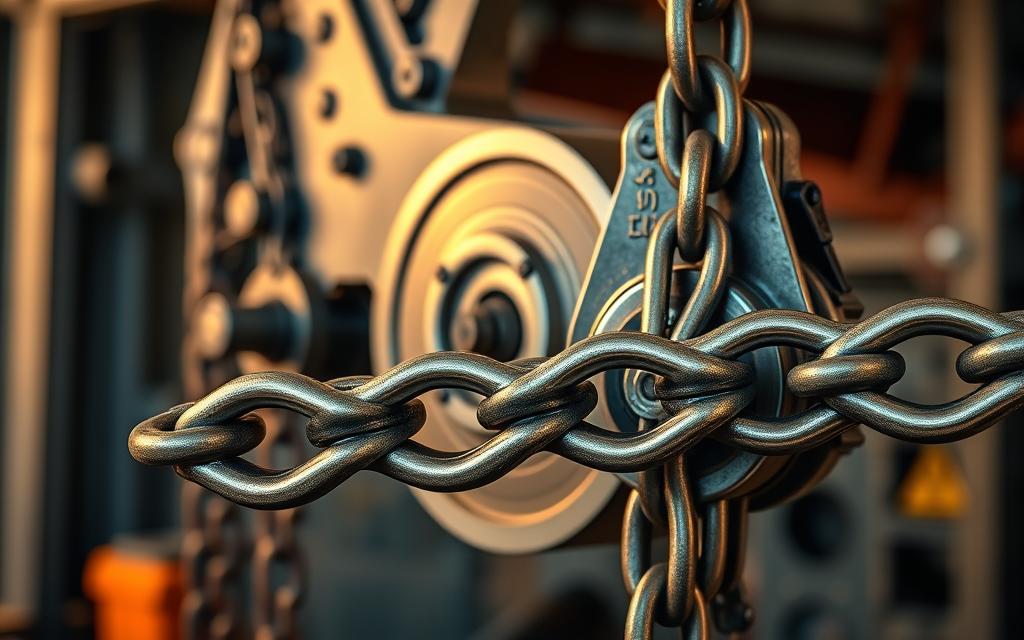
The load chain is the main part of a chain block. It carries heavy loads. Modern chains are strong but light, thanks to special load chain characteristics.
Chain Pitch and Link Design
The chain pitch is how far apart links are. It affects the chain’s strength and flexibility. A smaller pitch means the chain can handle more weight.
Each link is designed carefully to spread stress evenly. This helps the chain work well for a long time without breaking.
Surface Treatments and Corrosion Resistance
Chains are treated to last longer in tough conditions. Hot-dip galvanising adds a protective layer. Some chains also have polymer coatings for extra protection.
These treatments help the chain last longer. But, it’s important to check the chain regularly for any damage.
Gearing Mechanisms
The gears are the heart of a chain block. They help lift heavy loads. Different hoists use different gears for their needs.
Spur Gear Systems in Manual Hoists
Manual chain blocks use spur gears. These gears are simple and reliable. They make it easy to lift heavy loads.
Spur gears work together to make lifting easier. They increase torque and decrease speed, making lifting easier.
Planetary Gear Systems in Electric Hoists
Electric hoists use planetary gears. These gears are efficient and compact. They spread the load, making them strong.
Planetary gears are better at lifting heavy loads. They are also quieter and cleaner, which is good for many workplaces.
Braking Systems
Braking systems are very important. They stop loads from moving when they shouldn’t. They also stop loads quickly if needed.
Mechanical Load Brakes
Mechanical load brakes work automatically. They engage when lifting stops. They use friction to hold the load in place.
The beauty of mechanical load brakes lies in their fail-safe operation—they engage automatically when power ceases or the operator releases the hand chain.
These brakes keep loads safe without needing constant attention. It’s important to test them before using.
Emergency Stop Mechanisms
Emergency stops add extra safety. They can stop the load quickly, even if the main controls fail. Some hoists have special governors to stop if they get too fast.
Modern electric hoists also have electronic checks. They stop the load if something goes wrong. This makes lifting safer.
The Working Mechanism of Chain Hoists
Chain hoists work on simple yet clever principles. They lift heavy loads with ease. The design varies between manual and electric models.
Manual Chain Block Operation
Manual chain hoists turn human effort into lifting power. An operator pulls the hand chain to start lifting. This makes lifting heavy loads easier.
Hand Chain Movement and Force Transmission
When the hand chain is pulled, it turns the hand chain wheel. This turns the gears, creating a mechanical advantage. This makes the input force much stronger.
The gears change the long hand chain movement into short, powerful movements. This lets one person lift heavy weights that need many people or machines.
The gears turn, moving the load chain up. This lifts the object attached to it. The system stays engaged to prevent dropping.
To lower the load, the operator pulls the hand chain the other way. This disengages the braking mechanism slowly. This allows the load to descend safely.
Electric Chain Hoist Mechanisms
Electric chain hoists use motors instead of manual effort. They lift heavier loads and are easier to use in industries.
Motorised Drive Systems
The heart of an electric hoist mechanism is an electric motor. It turns electrical energy into rotational force. This drives the system with more power and consistency than manual models.
Modern electric hoists have well-designed motors. They work smoothly and reliably. This means less fatigue for operators and precise control over lifting.
Control Systems and Speed Regulation
Electric hoists have advanced control systems. Operators use controllers or remote devices to control lifting and lowering. This is precise.
These systems also have speed regulation. They can change lifting speeds based on the load. They start slowly to prevent jerky movements and ensure smooth handling.
Many electric hoists can be programmed for repetitive tasks. This makes them more efficient and safe in work environments. These systems show how lifting has evolved from manual to automated.
Types of Chain Blocks and Their Applications
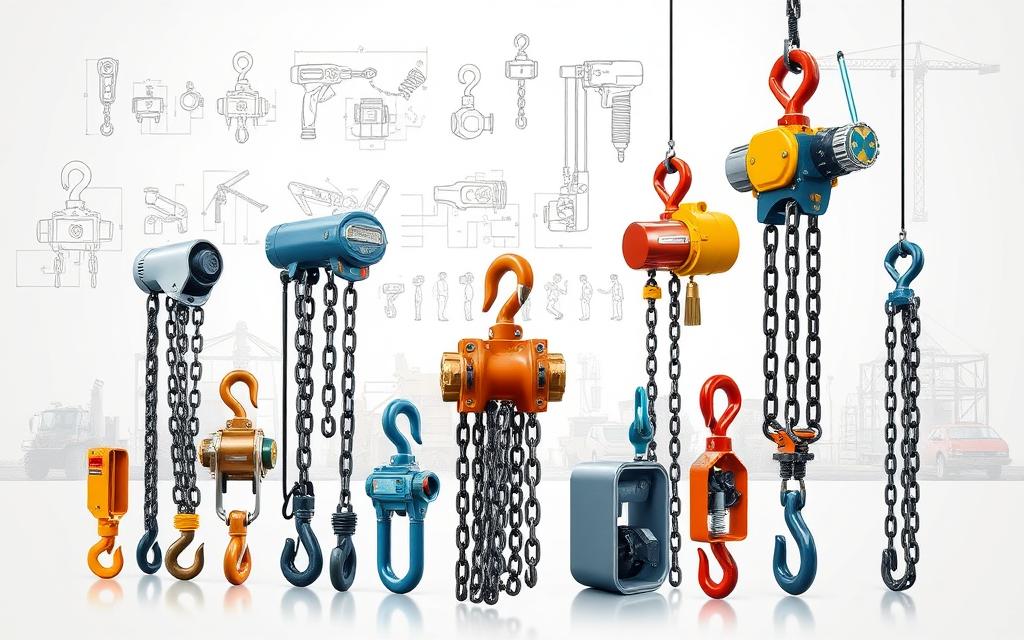
Chain block technology offers many solutions for lifting in different industries. Knowing the types helps professionals choose the right equipment for their needs.
Manual Chain Blocks
Manual chain blocks are reliable and don’t need electricity. They work by using human effort and mechanical advantage.
Light-Duty Applications
Light-duty manual chain blocks can lift up to 2 tonnes. They’re great for places like workshops and garages where lifting is not often needed.
They’re used for:
- Engine removal and installation
- Machinery maintenance operations
- Small component positioning
- Maintenance shop repairs
Heavy-Duty Industrial Uses
Heavy-duty manual chain blocks can lift from 3 to 20 tonnes. They’re strong and reliable for tough industrial settings.
They’re used in:
- Manufacturing plant equipment maintenance
- Construction site material handling
- Shipbuilding and marine applications
- Heavy machinery installation
Manual systems come in three main types:
- Fix type manual chain pulley blocks for stationary lifting points
- Manual chain pulley block with push pull trolley for basic movement
- Manual chain pulley block with geared trolley for precise positioning
Electric Chain Hoists
Electric chain hoists make lifting easier and faster. They work well for tasks that need to be done often.
Fixed Mounting Systems
Fixed mounting electric chain hoists are installed permanently. They offer consistent lifting at specific workstations.
They’re best for:
- Repetitive lifting at fixed positions
- Production line operations
- Precision load positioning
- High-frequency usage scenarios
Trolley-Mounted Configurations
Trolley-mounted electric chain hoists can lift vertically and move horizontally. They work on beam systems to cover more area.
They offer:
- Increased operational flexibility
- Reduced manual material handling
- Improved workspace utilisation
- Enhanced workflow efficiency
Specialised Chain Block Variants
Specialised chain blocks solve unique challenges and meet specific needs. They ensure safety and performance in various conditions.
Explosion-Proof Designs
Explosion-proof hoist systems prevent ignition in dangerous areas. They have special parts that stop sparks.
They’re vital in:
- Petrochemical facilities
- Pharmaceutical manufacturing
- Paint and coating operations
- Any environment with combustible materials
Low-Headroom Hoists
Low-headroom hoists save space in tight areas. They have a compact design for maximum lift with little overhead space.
They’re key for:
- Multi-level manufacturing facilities
- Buildings with low ceiling heights
- Applications requiring maximum lift height
- Space-constrained work environments
Each chain block type has its own role in different industries. Choosing the right one ensures the best performance, safety, and efficiency for specific tasks.
Safety Features in Modern Chain Blocks
Safety is key in today’s chain block designs. They have many systems that work together to avoid accidents. These hoist safety features are big steps up from older lifting gear.
Overload Protection Systems
Overloading is a big risk in lifting. Modern chain blocks use two ways to stop this: mechanical and electronic.
Mechanical Load Limiters
These devices stop the hoist from lifting too much. They use friction or stops to stop the hoist when it’s too heavy. This is a reliable way to protect against overload, no matter the power or electronics.
Electronic Overload Sensors
These systems watch the load with sensors. If it gets too heavy, they turn off the motor right away. Experts say, “If the load gets too heavy, a switch stops the motor.” This stops damage and failure.
Emergency Safety Mechanisms
Modern chain blocks also have emergency systems. These kick in when things go wrong, ensuring a safe response.
Upper and Lower Limit Switches
These switches stop the hook at set points. Upper limit switches stop it from going too high, which could harm the hoist or make the load unstable. Readers exploring chain block mechanism often end up considering canvas learning management system as part of the same topic. Lower switches stop it from hitting the drum or other parts. They use triggers or sensors to stop power when needed.
Emergency Descent Systems
When power fails or the motor breaks, loads need special care. Modern hoists have emergency descent systems for safe lowering. These systems use manual controls or backup power to safely lower loads in emergencies.
Today’s chain blocks have many safety features. They also have anti-drop and slip-resistant parts. This makes lifting safer. Regular checks keep these features working when they’re most needed.
Industrial Applications of Chain Block Technology
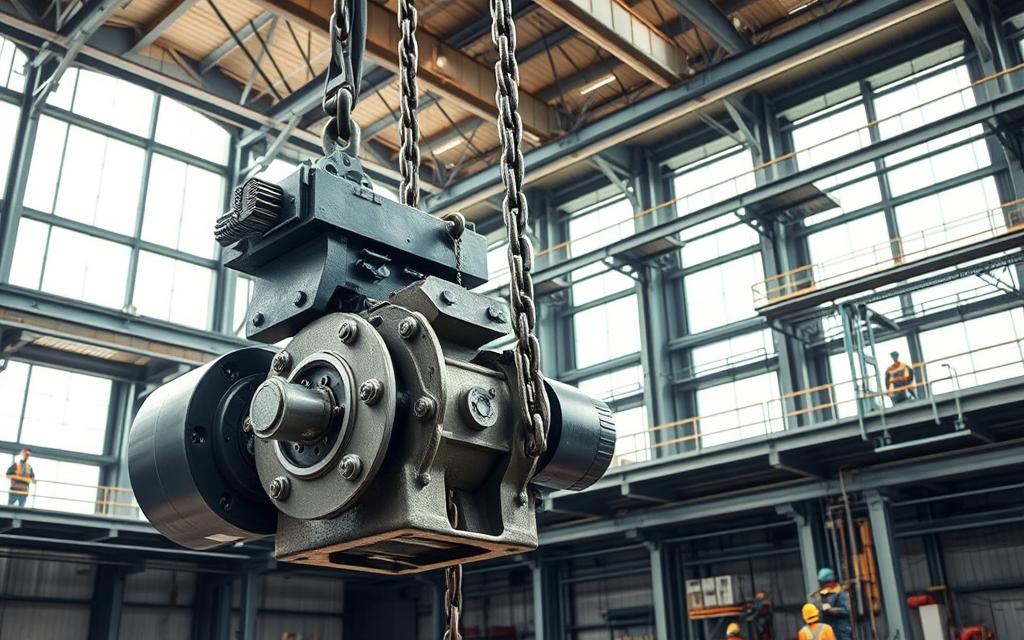
Chain block technology is key for handling materials in many industries. It’s used in car making and big building projects. These systems are strong and precise, making them vital for today’s work.
Manufacturing and Assembly Lines
Factories use chain blocks for their accuracy and ability to fit into systems. They help workers place parts with great detail. This leads to fewer mistakes and better work flow.
Precision Positioning Requirements
Today’s factories need parts placed exactly right, like in car and electronics making. Chain blocks can adjust in tiny ways, unlike others. This lets workers control loads closely while moving them.
Production Line Integration
Chain hoists work well with automated systems because they can be easily mounted. They fit with conveyor belts and robots, helping work flow smoothly. This keeps safety high in factories.
Construction and Infrastructure Projects
The building world uses chain blocks for their strength and ease to move around. They lift steel and machines. Their small size lets them work in tight spots.
Site Installation and Maintenance
Builders use chain blocks to put in HVAC, electrical, and mechanical parts. Maintenance teams use them for upkeep and fixing. Chain blocks are great for setting up and keeping things running.
Heavy Component Handling
Big projects need to lift huge items like generators and steel. Chain blocks can handle these heavy loads with care. They’re reliable for moving big, heavy parts safely.
Many industries use chain block technology, including:
- Construction – for structural installation and equipment handling
- Manufacturing – assembly line operations and component positioning
- Automotive – vehicle assembly and parts installation
- Shipping – cargo handling and container operations
- Mining – equipment maintenance and material movement
The versatility and reliability of chain blocks are why they’re so important. They offer precision, power, and ease of use. This shows how valuable chain block systems are in today’s industries.
Maintenance and Inspection Protocols
Keeping chain blocks in good shape is key. Regular checks and care help them last longer and keep everyone safe at work.
Routine Maintenance Procedures
Regular upkeep keeps chain blocks working well. It stops them from breaking down suddenly. This makes them last longer and work better.
Lubrication Requirements and Schedules
Using the right oil is very important. It makes the chain move smoothly and stops it from getting rusty or worn out.
Experts say oil is essential:
“Lubrication is required for the load chain to run smoothly and safely.”
Here’s a schedule for oiling:
| Component | Lubricant Type | Frequency | Application Method |
|---|---|---|---|
| Load Chain | Penetrating Chain Lubricant | Every 3 months | Brush or spray application |
| Gearing Mechanism | High-Temperature Grease | Every 6 months | Direct application to gears |
| Brake Components | Dry Lubricant Spray | Annually | Light coating on surfaces |
| Pivot Points | Multi-Purpose Grease | Monthly | Grease gun application |
Chain Inspection and Replacement Criteria
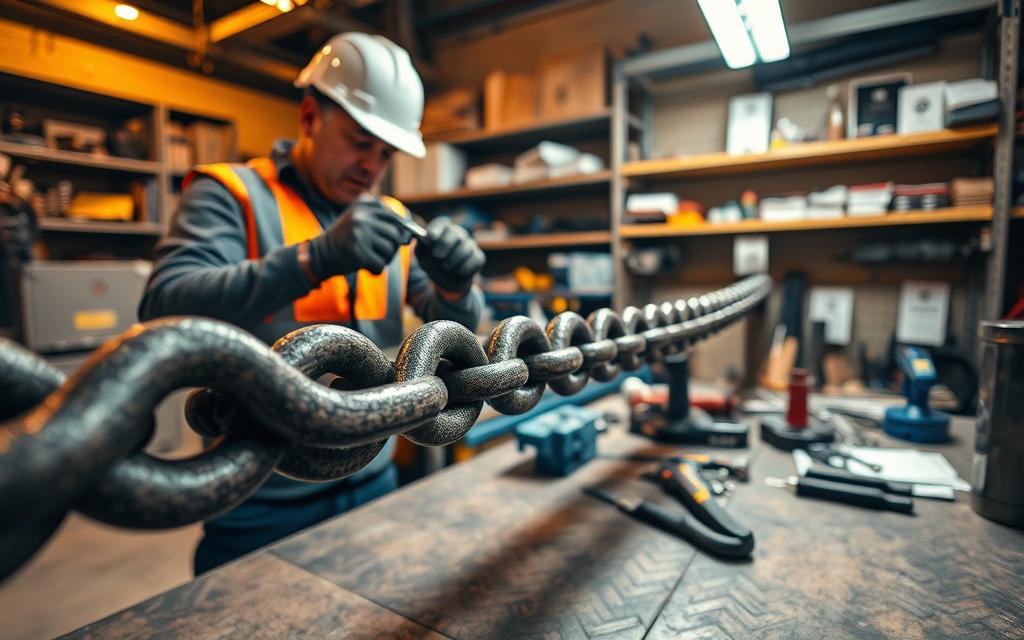
Checking the chain regularly is vital. It spots problems early. This keeps lifting safe.
Replace chains if you see these signs:
- Visible cracks or deformations in links
- Chain stretch exceeding 3% of original length
- Significant corrosion affecting structural integrity
- Worn links showing reduced diameter measurements
Safety Inspection Standards
Having clear safety checks is important. They help make sure everything is in good shape. This keeps everyone safe.
Visual Inspection Checklists
Looking over the equipment every day is a good start. It catches problems early. This keeps everyone safe.
Do these checks before starting work:
- Examine chain for twists, knots, or damage
- Verify hook alignment and latch functionality
- Check for loose bolts or fasteners
- Inspect brake operation through test lifts
- Look for oil leaks or lubrication issues
Load Testing Procedures
Testing the equipment regularly is key. It makes sure it can handle the job. This keeps it working right.
Experts say:
“Our inspectors are the best in the business and here to keep you safe and compliant!”
Here’s how to test it:
- Test at 125% of rated capacity annually
- Document all test results and observations
- Certify equipment after successful testing
- Maintain testing records for compliance audits
Following these steps makes work safer and more reliable. It stops accidents and keeps things running smoothly.
Comparing Chain Blocks with Other Lifting Technologies
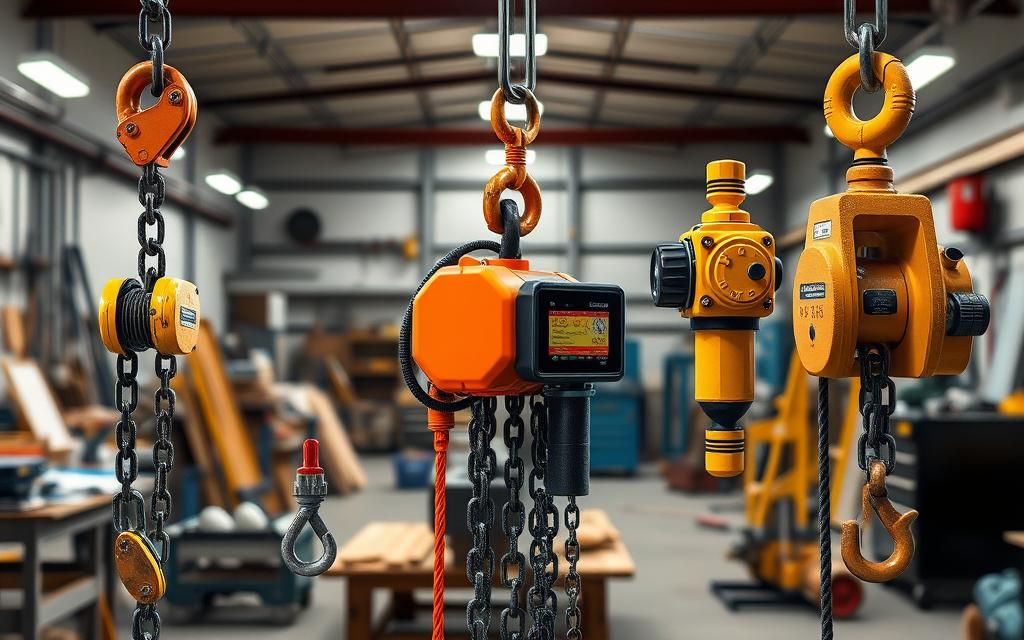
When choosing lifting technologies, professionals must weigh their options carefully. This chain block comparison looks at how chain blocks stack up against wire rope and lever hoists. We examine key performance areas.
Chain Blocks vs Wire Rope Hoists
Choosing between chain blocks and wire rope hoists is a common dilemma. Each has its own strengths for different settings.
Strength and Durability Comparisons
Chain blocks use alloy steel chains that resist wear and tear well. They stay strong even under heavy use.
Wire rope hoists, on the other hand, use flexible steel cables. But they may wear out faster in tough conditions. The cables can get damaged over time.
Experts say:
“Electric chain hoists need less upkeep and are easier to set up than electric wire rope hoists. Yet, wire ropes might not last as long as load chains.”
Maintenance Requirements Contrast
Chain blocks need less upkeep. Their sealed parts protect against dirt, cutting down on maintenance.
Wire rope systems, though, need more frequent checks and oiling. Their design means you have to watch for fraying and hidden damage.
These systems have different maintenance needs. This affects costs and how often they’re down for repairs.
Chain Blocks vs Lever Hoists
Chain blocks and lever hoists differ in how they work and what they’re used for. They meet different needs in material handling.
Operational Efficiency Differences
Chain blocks lift smoothly and precisely. They’re great for tasks that need exact height control.
Lever hoists, by contrast, use manual effort to lift. They’re good for tight spaces but require more strength.
Each system has its own efficiency based on the task and the person doing it.
Application Suitability Analysis
Chain blocks are best for simple vertical lifts where exact height is key. They’re often used in places that need lots of lifting.
Lever hoists, though, are more flexible. They can lift in many directions, unlike chain blocks.
“Lever Hoists can lift items in most positions, including horizontally. Unlike Chain Blocks, which only lift vertically.”
This flexibility makes lever hoists useful for pulling and working in hard-to-reach spots.
| Feature | Chain Blocks | Wire Rope Hoists | Lever Hoists |
|---|---|---|---|
| Primary Lifting Direction | Vertical only | Vertical only | Multi-directional |
| Maintenance Frequency | Low | Moderate to High | Moderate |
| Installation Complexity | Simple | Complex | Simple |
| Durability in Harsh Conditions | Excellent | Good | Good |
| Operational Versatility | Limited to vertical lift | Limited to vertical lift | High (lift, pull, position) |
This chain block comparison shows each technology has its own role. The right choice depends on the task, environment, and what’s most important for the job.
Industry Standards and Regulations
Knowing the rules for chain blocks is key for safety. These rules make sure the equipment works well and keeps people safe. Following these standards is vital for managing risks at work.
British and European Standards
The European market has strict safety rules. These rules make sure all products are safe and can move freely. This helps keep everyone safe and goods flowing.
BS EN 13157 Safety Requirements
BS EN 13157 sets safety rules for lifting tools up to 10 tonnes. It covers design, making, and testing. It makes sure the tools are strong and safe to use.
- Minimum safety factors for all load-bearing components
- Clear marking of working load limits
- Ergonomic design considerations for manual operation
- Environmental testing for various operating conditions
Manufacturers must test and document their products. BS EN 13157 focuses on avoiding overload and mechanical failure.
CE Marking and Compliance
CE marking shows a product meets European safety standards. For chain blocks, this means checking against the Machinery Directive 2006/42/EC. The process includes:
- Technical documentation of design and manufacturing processes
- Risk assessment and conformity evaluation
- Declaration of conformity from the manufacturer
- Type testing by notified bodies where applicable
CE marking means the product meets all European safety rules.
American Standards and Certifications
In the US, safety rules come from both industry and government. This mix creates a strong safety system for chain blocks in many industries.
ASME B30.21 Requirements
ASME B30.21 sets safety rules for lever hoists, including chain blocks. It’s from the American Society of Mechanical Engineers. It covers:
- Design, construction, installation, inspection, testing, maintenance, and operation
- Safety requirements for load hooks, suspension systems, and braking mechanisms
- Operational procedures for safe use in various applications
- Inspection criteria and documentation requirements
Following ASME B30.21 shows equipment meets high safety and performance standards.
OSHA Compliance Guidelines
OSHA sets safety rules for workplaces, including chain blocks. Employers must:
- Ensure all equipment is properly maintained and inspected
- Provide adequate training for equipment operators
- Implement safety procedures for lifting operations
- Maintain records of inspections and maintenance activities
OSHA rules are under 29 CFR 1910.179 for overhead and gantry cranes, which use chain blocks.
| Standard | Region | Primary Focus | Certification Body |
|---|---|---|---|
| BS EN 13157 | Europe | Hand-powered lifting equipment safety | European Committee for Standardization |
| CE Marking | European Economic Area | General product safety compliance | Manufacturer self-declaration |
| ASME B30.21 | United States | Lever hoist safety requirements | American Society of Mechanical Engineers |
| OSHA Regulations | United States | Workplace safety enforcement | Occupational Safety and Health Administration |
Knowing these rules helps companies choose the right equipment and follow safety steps. Following these rules keeps workplaces safe and reduces accidents.
Selecting the Right Chain Block for Your Needs
Choosing the right chain block is all about understanding your needs. This guide will help you find the best one for your work. It covers the key things to look for to ensure safety and efficiency.
Capacity and Speed Considerations
Getting the load right is the first step. If you guess too low, the block might break. Guess too high, and it will be too heavy to use.
Load Capacity Calculations
Start by figuring out the heaviest thing you’ll lift. Don’t forget to add extra for safety. Always add at least 25% to your total to be safe.
Remember, the weight isn’t just the object itself. Think about any extra parts or how the environment might affect it.
Lifting Speed Requirements
The speed you need depends on how you work. Manual blocks are good for slow, precise lifts. Electric ones are faster for when you need to lift a lot.
Think about how fast you need to lift things. Sometimes, slower is safer and more accurate.
When picking a chain pulley block, know its specs. Look at Load Capacity, Lift Height, Material Quality, and Safety Features.
Environmental Factors
The place you work in matters a lot. Different places need different kinds of blocks.
Indoor vs Outdoor Applications
Inside, you can usually use standard steel blocks. They’re fine in places where it’s dry and not too hot.
But outside, you need something stronger. Stainless steel and special coatings help protect against rain and cold.
Temperature and Humidity Considerations
Heat and cold can damage blocks and make them less effective. Heat weakens chains, and cold makes them brittle.
Moisture speeds up rust, which is bad for blocks. For wet or salty places, choose blocks that won’t rust like stainless steel.
Future Developments in Chain Block Technology
The lifting industry is on the verge of big changes. Digital innovation and material science breakthroughs are leading the way. These advancements will change how chain blocks work, stay in good condition, and handle tough tasks.
Smart Hoisting Systems
Modern chain blocks are becoming smarter. They offer better control and monitoring. These smart systems are the next step in future hoist technology, combining digital features with mechanical strength.
IoT Integration and Remote Monitoring
The use of IoT in hoists allows for real-time data collection and analysis. Sensors track important details like load weight, operation cycles, and environmental conditions.
IoT-enabled hoists bring many benefits:
- Remote monitoring through cloud platforms
- Instant alerts for any unusual operating conditions
- Analysis of historical data for better operation
- Improved safety through constant system checks
Predictive Maintenance Technologies
Predictive maintenance systems use data to predict when a failure might happen. This approach goes beyond regular maintenance to focus on when it’s really needed.
Advanced algorithms look at vibration patterns, temperature readings, and usage statistics. This gives maintenance teams precise advice, cutting downtime and extending equipment life.
Material Science Advancements
At the same time, material engineering is making chain block components stronger, lighter, and more durable. These advanced materials overcome old limitations and open up new possibilities.
New Alloy Developments
Research in metallurgy is creating special alloys with better strength-to-weight ratios. These materials also resist corrosion and fatigue better.
Some key developments are:
- High-strength steel alloys with better wear resistance
- Corrosion-resistant materials for marine use
- Materials that can handle extreme temperatures
Composite Material Applications
Composite materials are becoming a good alternative to metal. Carbon fibre and polymer composites are lighter but just as strong.
These materials are great for portable hoists and where weight matters. Research is ongoing to make composites even better at carrying loads.
The mix of digital smarts and material innovation is exciting for chain block tech. These changes will lead to safer, more efficient, and reliable lifting solutions in many industries.
Conclusion
This summary shows how vital hoisting technology is in today’s industries. Chain blocks offer reliable and versatile lifting solutions for many tasks. They make moving heavy loads efficient and controlled.
Understanding hoisting technology is key. Knowing about load chains, gears, and brakes is essential for safe use. Regular checks and following safety rules keep both equipment and people safe.
Chain block technology keeps getting better with new smart systems and materials. Its lasting value comes from mixing old reliable mechanics with new ideas. This discussion overlaps with used schools today modern, especially for readers comparing chain block mechanism with similar issues. This shows why chain blocks are essential for lifting in industries all over the world.
FAQ
What is chain block technology and how does it work?
Chain block technology is a lifting device that uses chains to lift heavy loads. It works by using gears and pulleys to make lifting easier. This makes it safe and efficient for lifting heavy things in factories.
What are the main types of chain used in chain blocks?
The most common chain is Grade 80 alloy steel. It’s strong and lasts long. It’s treated to make it even better for heavy work in places like construction and factories.
How do manual and electric chain hoists differ in operation?
Manual chain hoists need someone to pull a chain to lift or lower things. Electric ones use motors for more power and speed. They can be controlled easily with a pendant controller.
What safety features are incorporated into modern chain blocks?
Modern chain blocks have many safety features. They have systems to stop if too much weight is lifted. They also have emergency stops and switches to prevent accidents. This makes them safe to use.
In which industries are chain blocks commonly used?
Chain blocks are used in many places. In factories, they help place parts exactly right. In construction, they lift big parts and machines. They’re also key in logistics and warehouses.
What maintenance is required for chain blocks?
Keeping them in good shape is important. This includes oiling, checking for damage, and following safety checks. Always follow the maker’s instructions and industry rules to keep them safe and working well.
How do chain blocks compare to wire rope hoists?
Chain blocks are more durable and take up less space. Wire rope hoists can lift faster and higher but need more care. The right choice depends on what you need, like how heavy the load is and where you use it.
What standards and certifications apply to chain blocks?
In the UK and Europe, they must meet BS EN 13157 and have CE marking. In the US, they must follow ASME B30.21 and OSHA rules. This ensures they’re safe and legal to use.
How should I select the right chain block for my needs?
Choose based on how much it can lift, how fast, and where it’s used. For harsh places, choose ones made to resist corrosion. Think about the temperature and how often you’ll use it.
What are the future trends in chain block technology?
New things coming include using IoT sensors for better monitoring. There will also be stronger and lighter materials. These changes aim to make lifting safer, more efficient, and more durable.